Showing posts with label El Salvador. Show all posts

Monday, March 30, 2015

Chilateada in Izalco - Easter Monday

Is Easter Monday a thing? I don't think it is but I'm making it into a thing. It's certainly treated as one here in Izalco, El Salvador where the Monday of the Easter week is the last day during the whole Easter festivities extravaganza when chilate is made and served to the hungry pilgrims traveling long distances to pay their respects to Christ. If you don't know what chilate is see previous posts. Today, a pick-up load of SS city dwellers, aka myself and some others including my abuela, made the journey to Izalco to observe our pious duties. And there we were, inside this little white and purple church listening to a wailing rendition of Ave María being blasted from some old speakers, stomachs rumbling, mouths watering and eyes burning from the combination of pine incense for the deities and wood fires used to prepare the chilate for us mortals. I think we got the better end of the deal.

It is customary to pay your respects to Christ i.e. make a donation to the church, before approaching the food area. Once this is done and you have received proof of payment in the form of a sticky coconut palm flower, you can casually make your way over to the kitchen area and observe, maybe even participate in, the cooking process. I had never seen this being done so I was intrigued to see the whole process of grinding, pounding, soaking, straining, flavoring and finally cooking. It was impressive to see the sheer quantity of maize flour that was being moved from one station to the next. Once the maize has been ground and pounded, it is soaked in water to produce a milk-like liquid. This is then strained using cheese cloth or muslin and the liquid is cooked in large pots over an open fire. When the liquid is finally of cooked and thick enough, you can exchange your stick coconut palm flower for a portion of delicious goodness. Chilate is served hot in little bowls with a serving of local sweets. You can get an idea of what the preparation process looks like below:

Straining the 'corn milk'

Heating and stirring. These are not a tiny women.
Unfortunately for us the chilate was not ready when we arrived and even after walking around Izalco, we were not patient enough to wait another hour. Attempts at chasing the Easter processions were unsuccessful and a Salvadoran democratic decision was made (interpret this as you like). We made our way to Sonsonate wanderlusting after food and more adventure. It's always nice to visit the little towns and view the sites. It is sometimes very easy to forget the beauty of the changing landscapes, lava fields, sprouting sugar cane, volcanoes and colonial churches given the current social situation, and it is nice to be reminded.

Main Izalco church and the Volcan de Izalco in the background.


Wednesday, September 17, 2014

Piñatas in Santo Domingo de Guzmán - El día de la mujer indígena

Traditional Salvadoran dress - La volcaneña
Santo Domingo de Guzmán is a small village in the department of Sonsonate in western El Salvador. Contrary to popular belief, El Salvador is the home of three separate indigenous groups, descended from the Aztec families of Northern Mexico. These are the Lenca, Cacaopera or Kakahuiles, and the Nahuat-Pipiles. While the language of the Lenca and the Cacaopera is believed to be completely extinct, Nahuat can still be heard in some locales, and might even be undergoing successful revitalization, though it is really too early to tell. One such place where Nahuat can be heard is in Santo Domingo de Guzmán, a small village in the department of Sonsonate in western El Salvador. 

"Dale dale!" - Hit it!
This past weekend, I along with my cousin and some friends from the Tzuntecun Ejecat collective went to Santo Domingo de Guzmán to celebrate indigenous women's day (el día de la mujer indígena) with the people of Santo Domingo. It may not look like much, but this celebration marks a very important event in the history of Santo Domingo, as it is the first time the indigenous women of the village have ever been celebrated in this manner. With the help of a marimba duo from Izalco, some young volcaneñas, generous helpings of horchata sponsored by the mayor of Santo Domingo, a theatrical piece by the Tzuntecun Ejecat Collective, and a good old fashioned piñata 'to help us remember the children we once were', the indigenous women (and men) celebrated their unique cultural heritage as Nahuat speakers. Coincidentally, it was also El Salvador's national independence day weekend, so it was pretty great to see everyone celebrating their individual and collective identities on such a day.

Here's to many more of these celebrations:


Giving the piñata a good whack


The wonderful people of Santo Domingo de Guzmán and Colectivo Tzuntecun Ejecat

Saturday, February 2, 2013

Adios amigos


I have now left El Salvador to return to the cold temperatures of Europe. It is time to face the world again so I will probably disappear from this blog for a few months. In the meantime, I leave you with two lovely collages and a link to a new and exciting project/blog currently being conducted by my mother to trace and uncover my family's Chinese/Mexican heritage. The blog is written in Spanish, but it has lot of old pictures as well as information about the start of globalization and the mixing of cultures way back in the 16th Century.

buscandoalabuelo.blogspot.com

Hasta luego!

Friday, February 1, 2013

Roaring beast in the night

How I love earthquakes. The quiet roar of approaching tremors like a silent beast in the night announcing its impending arrival. The roar of an earthquake is not something you immediately notice in the daytime. Perhaps you are more preoccupied about buildings falling down around you and crushing you to smithereens. At night however, in a blissful dream like state their arrival is almost magical.

We had two earthquakes last weekend, at a magnitude of 4.5 - strong enough to raise people from their slumber but not strong enough to raise the alarm. The first one was a quick but tremulous jab to the ribs, the second, like I said, a stealthy roaring beast attacking in the night. Granted, I was half-asleep and it is very likely that my dream-like state has affected my perception of the tremors, but after the initial alarm the trembling earth rocked the population back to sleep with a friendly good bye.


Sunday, January 20, 2013

Sunday - Market day

Previous Sundays have consisted of attending Catholic mass, weekend trips to the beach or country, or visiting family. Today though, we did something old, something we used to do when I was but a wee chipilín, munching happily on raw sugar cane.

We went to the market. Grandma had a hankering for a bowl full of chilate, a rather tasteless broth or atol, served with a side of sweet syrupy buñuelos or nuegados. Previous experience had taught me I was not the biggest fan of this afternoon snack. But in the food's defense, I had based my harsh judgement on samples provided to me by Mister Donuts - if you have never heard of Mister Donuts click here, but it is basically an antique American fast breakfast food franchise from the 50s that has remained popular in El Salvador. How wrong was I to dismiss this local dish based on Mister Donuts' cold, bland and chunky interpretation.

So what is chilate? It is a water-based broth made out of toasted maize flour, whole peppercorns and ginger, thickened slightly with corn starch. In Mexico, it is very common to add chili and cocoa beans which is where the name comes from, but in El Salvador, the broth is not condimented too heavily so as to better compliment the side of buñuelos and/or nuegados. To me, a bowl of chilate is nothing without its sweet syrupy counterparts and vice versa. The term nuegados means nuggets and refers to sugared plantain or sweet potato chunks. Sugared pumpkin on the other hand is prepared with cinamon and brown sugar loaf and is called ayote. If you go to one of the popular food chains which sell local food (e.g. Mister Donuts or Typicos de Margoth) buñuelos are large male fist-sized profiteroles, deep fried and covered in sugar and brown sugar loaf syrup. They are made out of egg and wheat flour, usually slightly hard and stale and far too big and sweet to be consumed by one person. You are better off visiting a local market, or keeping an eye out for street vendors pushing around their chilate cart between 3-4 in the afternoon. Their approach is often marked by the echoing sounds of "chiilaaaaaaaate...."

Today, in a market close to Santa Tecla, the chilate lady had plenty of options on offer. The drink itself is always the same, served piping hot in a gourd with the occasional floating peppercorn. The sides are a different matter with various choices crispy yet chewy egg or yucca buñuelos, and flavorsome plantain, sweet potato or pumpkin nuegados.  I had a serving of nugget sized yucca buñuelos and ayote candy with syrup, the perfect contrast to the peppery broth on a cool afternoon.

Sunday, January 13, 2013

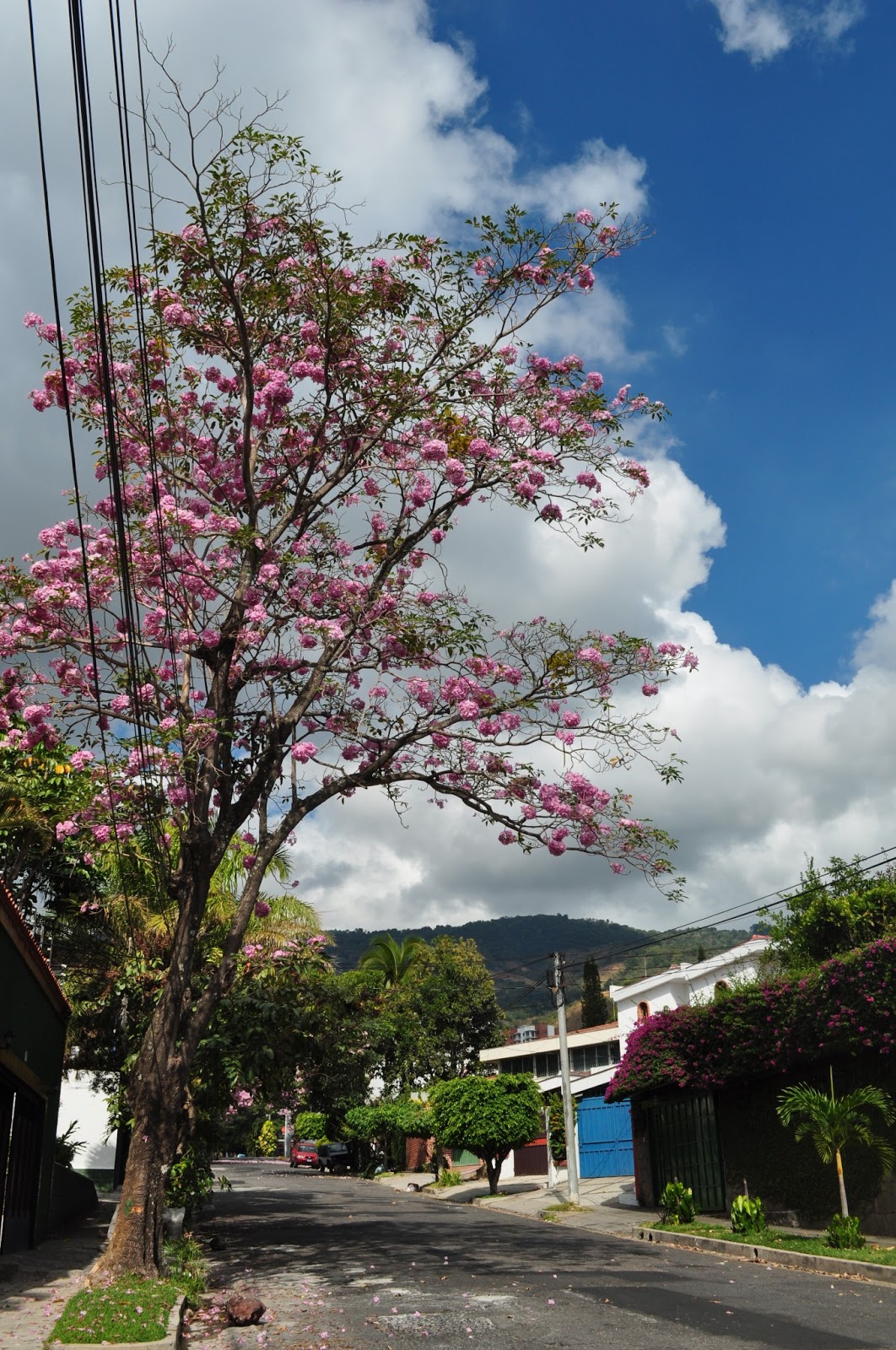
Maquilishuat - Tabebuia Rosea

Let me introduce you to El Salvador's national tree, the Maquilishuat (pronounced ma-ki-liz-wat) also known as the Roble de Sabana in Costa Rica, or by its Latin name: Tabebuia Rosea. It flowers from mid-January to the end of February much like the Japanese Cherry Blossom tree. According to the Wikipedia page its bark has various medicinal properties, but I'll be able to tell you more about that next year maybe.

Its flowers are medium sized and vary from a pale violet to a vibrant pink. They line the streets with their delicate petals and have a very faint sweet scent.


Saturday, January 12, 2013

Puerta del Diablo and Panchimalco

Tourist day!

And what a day it was. Starting first with a productive culinary morning of homemade coconut milk, green mango chutney and a risotto-ish experiment (which turned out pretty good if I do say so myself), a couple hours later Abuela, Henry and I were off for a new Salvadoran adventure. First stop, Panchimalco.

Panchimalco is one of El Salvador's few historic towns, popular with gringo tourists such as myself for the visible Pipil and colonial influences. You've entered Panchimalco once you reach the cobbled streets and white washed houses with colourful doors. If you visit the town on a weekend, and head over to the church, you will meet Don _ the local Pipil expert who will greet you in the Panchimalco variant of Nahuat. He's a nice enough guy and since it's a tiny town he'll show you around the place and recommend sites like Miguel-Angel Ramirez' art studio and the Panchimalco Cultural Centre. I did not visit either of these, but Miguel Angel Ramirez for example is one of El Salvador's most famous artists known for his children's portraits. So if you're into art, his studio is definitely worth a visit.

The Panchimalco church is one of my favorite churches ever. And I swear I'm not really into churches at all. This one however, is made almost entirely out of wood, with the exception of the front façade which is made out of clay or brick(?). That last part needs to be confirmed. The inner floor is made out of clay and the interior structure is decorated with beautifully crafted wooden beams and altars. The front altar is another elaborate wooden structure which houses various figures of the Virgin Mary, Christ and other saintly figures. It reaches up to the domed wooden ceiling of the altar room. This church is the oldest surviving colonial structure of El Salvador having been built around 1725.
Panchimalco church and Puerta del Diablo

Facing the church, camera poised to take a picture, you will notice prominent cliffs to the left of the church. This natural formation is known as the Puerta del Diablo, the devil's door, and is also well worth a visit if you're up for a short climb that will provide you a full circle view of El Salvador and its major landmarks such as the San Salvador Cathedral, San Vicente (otherwise known as Chichontepec - the big breasted volcano), San Miguel volcano, and Ilopango - El Salvador's biggest volcanic lake. There are many myths and legends surrounding the devil's doorway, the most obvious one being that here lies the devil's entrance to the underworld. But as the entrance to the underworld is yet to be found, plenty of locals and gringo tourists make their way over for a spectacular view. You'll also get a taste for Salvadoran culture from the rastafarian moteros selling hemp products nestled on the side of the cliff, to the reggaetoneros blasting 70s rock at the foot of the cliffs. If you're extra adventurous be sure to wear stilettos for the steep upward climb.

Photies - click to enlarge


Panchimalco church details


A tiny doorway


San Salvador and Quetzaltepec volcano

El Salvador del Mundo - The Saviour of the World, famous monument

Thursday, December 20, 2012

Christmas - Tamales

'Tis the season to be jolly and eat like nobody's business. Already tummies are starting to swell with contented pies and cookies. Turkeys have been distributed (although this is really a North American tradition that has been adopted by Salvadorans), fragrant spices and oranges bought, festive pupuseadas organized, and pre-ordered tamales collected. The freezer has been filled with chilaquilas and chancletas alike, and various new years gifts, including calendars, cookies and pomelo fruits have been distributed to friends and family. I have yet to see mariachis though.

Traditionally, Christmas - although the more I think about it the more alien the concept of Christmas, the turkey, the presents, the pine tree, becomes. I seriously doubt the Pipiles, the Cacahuiles and the Lenca celebrated Christmas. They probably celebrated the end of the year though, much like the Maya did by building a fire pit to bid farewell to the old year and welcome the new dawn with a fresh bed of pine needles, rosemary and incense. But back to food and El Salvador. Sadly, not very much is known about the traditions of the indigenous people of El Salvador and traditional Christmas means nothing to me. I do know however that before the turkey revolution, it was customary to eat tamales.

Tamales come in various shapes, sizes and flavours. Each central american country has a version of its own, with its own unique combination of flavours. Generally though, a tamal consists of some sort of corn dough wrapped in a large leaf. Mexicans and Guatemalans enjoy dry tamales wrapped in corn husks. When unwrapped the inner dough is very bready and delicious with cream or cottage cheese. They make a great travel snack and are easily portable.

Salvadoran tamales are decidedly juicier. They take two days to make, and tamaleras - women who make tamales, are known for their upper body strength needed for the continuous mixing of the corn masa over an open fire. As well as the masa and the banana leaves which need to be prepared in advance, a chicken broth flavoured with tomatoes, potatoes, chickpeas, green olives, capers and raisins  is cooked on a low heat overnight. Then with a process also employed by pupuseras, the dough is skillfully shaped to resemble a canoe, filled with delicious broth, bits of chicken and vegetables, sealed, wrapped in banana leaves and finally, boiled for 30 minutes. The end result is a type of congealed pie filling nested within a packet of banana leaves which can be enjoyed on its own or with a side of tortillas.

Now, you might be thinking, "Salvadoran food is not very vegetarian friendly" and you would be right. It is not. However, the tamal offers one of those rare instances where a vegetarian option is available in the form of tamal de chipilín, chipilín being a little local herb I haven't quite got my head around yet. Although it is widely used in Central American and Mexican cuisine and has a pleasant enough taste, it is almost instantly forgetable. I could not, in fact cannot describe its flavour. Nevertheless, chipilín tamales are tasty and suitable for all except vegans. That's another story.

Wednesday, November 28, 2012

1932 peasant uprising

It's incredible the hidden historical and cultural gems that are buried and completely disregarded in this country. On the one hand it's a completely unique and unadulterated experience, walking through the heavy wooden doors that machetes hacked away at with animus intent, to explore the historic interior completely free of any supervision. On the other it's alarming and saddening to see such beautiful historic buildings such as Casa Barrientos in Izalco, literally crumbling to pieces before your very eyes.

In December of 1931 civil unrest peaked due to the collapse of coffee prices on the international market. Full on fighting broke out on January 22, 1932, led by communist insurgents, and the peasant revolution which pretty much anihilated all of El Salvador's indigenous communities, began. Angry peasants and farmers gathered in front of Casa Barrientos Frankenstein style with machetes and pitchforks, yelling in protest at the unjust conditions and results of the agricultural reform. Military forces intervened and the rest is history.

Today, not much has changed. As a result of that war, many legal property titles were lost or destroyed and the ownership of these properties was reassigned to members of the Salvadoran military.  Farmers who for generations have lived off the land, since 1932 have been forced to pay a portion of their proceeds to those in power. After talking to agricultural farmers in Nahuizalco, it seems that these farmers will be forced to relocate once again to undisclosed location in January 2013.


Sunday, November 18, 2012

Beans

I like to think of El Salvador as the land of beans. The bean, particularly the Salvadoran red bean, is a very important staple in traditional Salvadoran food. It is a food which can be served as a side, a main, a dessert, and even a condiment to the ever popular pupusa. So the local saying goes "you can take away a poor man's meat but you can't take away his beans". At a first glance the trusty bean can even be said to be part of our national flag, the centre of Salvadoran peace and glory, the epitome of much love and adoration which has been bestowed on this staple food:


There it is, the heralded red bean, highlighted by the glow of the setting sun, underneath the pro-gay rainbow of peace. This however is just my personal interpretation. In reality this "bean" cap is actually the gorro frijio (not frijol), a Phrygian cap also known as the cap of liberty represented in Delacroix's Liberty Leading the People, and more popularly worn by the smurfs. Yes, a smurf cap features at the centre of my country's national shield. I prefer to think of the cap as a liberty bean. The bean that fed and supported the leftist guerilla movement 30 years ago. But let's not get political here.

Over the past month I have eaten green beans, white beans, black beans and best of all red beans. I have had them stewed, boiled, fried and blended, for breakfast, lunch and dinner in soups, tacos, rice, pies and salads. The abundance of beans in this country and its great nutritional value is one of the main reasons why the population remains so well fed and rotund. And my favorite bean combo to date? Bean puree fried with garlic and coriander served with a side of plantain. Trust me, it's delicious.

Tuesday, November 13, 2012

Death of a Moth

One of the things that I find particularly interesting about the people and culture here is how superstitious they are. Everyone I speak to has their own personal encounter to relate, whether it be with a ghost, a spirit, the devil or a shape shifter. Normally I would say this is all a bunch of tosh, but I think in this case Roque Dalton may have a point with his reference to the indigenous massacre of 1932.

Ser salvadoreño es ser medio muerto, eso que se mueve es la mitad de la vida que nos dejaron
"To be salvadoran is to be half dead, all that moves is half the life that we were left with"

It's almost natural that a population which has suffered from so much death, such as the civil war (1979-1992) and the mass genocide (1932), should claim such proximity with supernatural beings. Even I have had my own personal 'encounters' with spirits here being the non-believer that I am. This is leaving me decidedly suspicious of the supernatural world.

The most common sightings are those of cadejos, old women in lace, and moths. Depending on the circumstances, a visit from any of these in the dead of the night can be considered as an omen or a promise of good things to come, but they communicate a message to the 'half dead' of what is to come. Bearing in mind that this is not your regular closet moth, it is common belief here that moths are bad omens being the reincarnated spirits of the dead. If a moth visits your home in the night it is a sign that bad luck will soon come a'knocking. If someone close to you is severely ill, the visit of a moth indicates the proximity of their death. The moth in question is the Black Witch moth, dark brown with a pale leafy pattern, large enough to be mistaken for a bat.

Cadejos in contrast play the role of the guardian angel/demon in the form of a dog. There are many different versions of the role they play in various myths and legends, but from what I can gather, there seem to be two differnt kinds. The white cadejo is good, and if you encounter him deep in the forest he will accompany you and lead you to safety. The black cadejo however is bad and likes to play tricks on people and will lure the unsuspecting down the wrong path to their unfortunate death.

Finally the old woman in lace seems to represent all of those who have since passed. She wanders alone in the dead of the night lamenting the violence and the suffering of her people. She is often seen sitting and waiting, although nobody seems to know what it is she is waiting for.

I leave you with the rest of Roque Dalton's poem:

"Unámonos medio muertos que somos la patria
para hijos suyos podernos llamar
en nombre de los asesinados
unámonos contra los asesinos de todos
contra los asesinos de los muertos y los mediomuertos."

Let us unite half-dead as we are
So that our children can call us
In the name of the dead
Let us unite against our assassins
Against the assassins of the dead and half-dead. - Own Translation

Saturday, December 31, 2011

Home for the Holidays

Home. Family time. Abuelos. Tios. Primos. Speeding. Curves. Jungles. Volcanoes. Black velvet sand. Atitlan. Maya. Photo shoots. Languages. Snorkeling. Sting rays. Squid. Baby turtles. Roaring currents. Sun. Fresh air. Shit music.

If my appreciation of Christmas were based on food alone, this would not be my favorite holiday. Formal family gatherings and extended holiday celebrations have become considerably more complicated since becoming a vegetarian. Nevertheless a bit of home time surrounded by my crazy family is always refreshing. Needless to say there is never a dull moment. The parties and gatherings which are supposed to be a blast - literally with all the fireworks set off - never are, and the impromptu visits evolve into full fledged adventures becoming ingrained into your memory forever.

It's a bit of family tradition I suppose to cram as many activities in as many different places, in this case as many different places in Central America, when we're together. The traveling gene is very much ingrained whether it's by plane, boat, bicycle, car, or bus - sadly there are no trains here. One day you're stepping off the airplane just to pack a different bag which will accompany you for the next 2 weeks. The adventure begins with the sun rising over a misty Guatemala City as it falls away from you and you dive into the clouds. Next thing you know, you're zooming across turquoise waters, diving with squid and stingrays, surfing with dolphins and observing missionaries and narcos interacting. San Pedro is a small island in Belize which I'm told used to be a little haven away from home. Its two block commercial area has turned into a full fledged centro comercial, but at the end of the day it's still an island small enough to traverse various beaches in the hunt to find your father who's on the hunt for windsurf equipment but big enough to cycle an entire day and not get all the way around. Time slows down and the sun is warm. From here, it's back for a day and on to the next destination.

El Salvador is an amazing country even when compared to the cultural giant which is Guatemala. Of course, I'm biased. There's no questioning that streak of patriotism which invokes hyperactivity on arrival and "blows dust in my eyes" on departure, but where else can you physically feel the power of the earth and its roaring oceans, see rocks come to life, and hear the twitter of diversity? You can scale the face of a volcano to find yourself in a field of hummingbirds, flowers and butterflies. You jump in the ocean to get tossed around like a rag doll as you throw yourself against 1.5 meter high frothy waves and emerge laughing covered in black sand. You burn your feet on the sand and cool them off in the ocean. At sunset, you can hear the clicking of canegues (hermit crabs) clambering over black silky rocks as they scavenge for food. The people are friendly and genuine, laughing, smiling and open. The food is heavy and filling. Cheese lovers, you'll never find a cheesier and more satisfying dish than pupusas. I don't care if the name is funny, once you try them you love them. The politics are exciting and despite the high rates of internal corruption, there are many good people within the system.

Another early morning start, three hours later we're back in Guatemala City for a couple hours before getting back on the road this time to the Mexican border. There's an archaeological site called Tikalik Abaj which for all the hassle, the bad roads, potholes, and pitch black darkness, I didn't even get to see much of, but from what I did see, I would go back again. The Tikalik Maya Lodge was one of the coolest hotels I've ever been to, especially for being an eco-hotel. The rooms are large and spacious, completely environmentally friendly (no electricity yes) but plenty of hot water and amazing views from your roof top balcony.You wake up with birds singing and the rainforest at your doorstep. I'm not particularly fascinated by birds but you can't help but be amazed at the sheer variety of bird calls, and bird sightings of all different colours and shapes. Another three hour race for your life past sugar cane trucks, across the agricultural basin of Guatemala and down death provoking curves and you're in Lago Atitlan appreciating the deep turquoise waters and the view of seven volcanoes. Temperatures are mild at this time of year but it's the only time you can really swim in the lake. Panajachel is one of the few places in Guatemala where both men and women walk in the streets wearing their traditional outfits.

That basically sums up two weeks of being home, a flurry of activities, nearly four countries and it all culminates here on the brink of the New Year surrounded by notebooks, journal articles, yellow notepad paper and a very clingy cat preparing to pounce on the last slice of semita

Wednesday, July 6, 2011

Sundays in San José Villanueva

La Hacienda

Wake up to the drip drip of the remnants of a violent thunderstorm. Parakeets chirp in hushed tones underneath a blue beach towel, quietly discussing the hot topics of the day. A cat flies in through the window and lands with a thump on your stomach, dashing off without so much as a "Good Morning" to your interrupted sleep. Somewhere in the house a shower handle squeaks and water gushes. Footsteps pad their way over and a blurry face appears in your line of sight.

"You comin' to church?"
"Urrrrrr"
"Good, 10 minutes"
"Urrr"

Twenty minutes later I'm sitting in the front pew like the good catholic I am not, watching in wonder as the funny man dressed in green humms and haws, spits and spews the Holy word of God unto our ever attentive ears. Well, their attentive ears. I don't even remember what the sermon was about. What I did make a note of however, was how much this particular church has grown in the past few years. I am the expert of course, having attended this church on average about twice a year for the past four years, Easters and Christmases included, along with random Sundays of the year. The church of San José Villanueva now has a certain feeling  of utility and warmth which wasn't there at the start. It's a big square "modern" building with tiled floors and wooden pews. The whole town flocks to its doors to fill its seats and listen with fervour to the good pastor. Testimonies of the church's good deeds are given, money to fund local farmers' harvests collected, scholarships for university degrees handed over, requests for a replacement tire for the community's mini bus were made, even the local drunk homeless man made an appearance in a bright blue polo shirt and khaki pants. A whole hum drum of activity which has slowly made itself a key aspect of these people's lives.

Or you could look at it from a different perspective. See those two rows of gringos four rows up? White faced, broad shouldered and stiff necked? They're a special congregation visiting from Misouri on their yearly rounds to monitor how their contributions are being spent by their sponsored missions. Puts everything into a different light.

Church over, the smell of huevos rancheros guides you home so you can stuff your face and fall into the lazy Sunday rythm, interrupted only by the journey to the bus stop. Guatemalan city life beckons. 

Thursday, June 16, 2011

Salvadoran Legislative Court

A good friend of the family received a very distinguished award from the legislative branch of El Salvador's very apt and capable government so the three females of this family (excluding the cat) bundled ourselves in the car and sped away through rain and thunderstorms to attend the award ceremony. I am now proud to say that I have been inside the buildings of El Salvador's central governance, have sat with the who's who of El Salvador's political royalty (although I did not know it at the time) and have watched bemusedly as my mother the photographer flitted back and forth among all this grandeur, unapologetically pointing a 30cm lens in people's faces.

What can I say, it was exciting for all about 10 minutes until we all realized hardly anything could be understood over the incessant chatter of gossipy women sitting in the back corner of the legislative court. Who gossips in a legislative court?!

It was really interesting though. I felt like I was in an episode of the West Wing: El Salvador, sitting on the edge of my seat waiting for a glimpse of our president Mauricio Funes in the midst of drama and action. He never showed, apparently was never supposed to. Only the likes of ARENA's Calderon Sol (cough), and the Minister of Defense and other important people which I remained completely oblivious to. There was talk about the war, the progress that has been achieved, and of course my uncle's involvement in this progress and all of his achievements. All had good things to say, it got very political at one point which was when the gossiping hit its peak, and a couple flashes later it was over. Four females bundled themselves in a car and sped away home.

Saturday, April 23, 2011

Californiaaa 18.04.2011


Sitting at the airport for 8 hours, finishing postcards which won't get sent till the end of the month, watching Glee and chatting to randomly friendly men.

“So where are you from?”
Right in the middle of an episode here, “uh, El Salvador”
“Oh wow, me too!”

Which isn't so surprising in the States since roughly half our population are currently living here. Six hours and a greasy panini later, at the gate still watching Glee another man starts...

“Where are you headed?”
Sigh. “Guatemala”
“Oh, yo tambien. Sos Guatemalteca?”
“No, Salvadoreña”
“Pero vives en Guatemala? Donde?”
“En la ciudad”
“Ah vives con tu esposo?” - This question always makes me laugh, but I should really start lying in response.
“Jaja, no”
“Pues yo vivo en la costa pero de vez en cuando voy a la ciudad, que tal si te doy una llamadita?”-
Eew, how old are you man? “No tengo telefono. Ademas me voy a El Salvador a vivir con mis abuelos.”
“Entonces tales nos vemos alli!”
!!!

Sunday, January 16, 2011

Basantapur

It took me 9,339km, 15 hours flight time and a good dose of Vietnamese culture and noodles to make some German friends. Now 2,961 km due West, and a good 15,281.2 km from the source, I can expand my Salvadoran posse. Seriously, the world is bizarrely small at times, yet at the same time this experience is about how massive the world really is despite the current facilitation of travel and communication and resulting globalisation. The world is huge, but the community of globetrotters is tiny in comparison.

Today I happily revived my Latin roots and two Salvadorans set out to explore the secrets of Kathmandu. Armed with two massive cameras, a map which came out every 200 metres, sweaters, scarves, converse, no money but lots of gusto, we set off from the suburb of Patan in true Salvadoran fashion and walked north. Walked and walked and walked, until the map was rendered useless and the meandering streets gave way to conning shamans and multilingual drunken hindus.

“You have camera, take picture?¨
“Is that ok?”
“Yes, yes, make a donation”
“But we don't have any money”
“Ok ok, no money is also ok”
“Que pensas, le tomamos foto?”

“Va, andate pues, te tomo la foto”
“Ok, you take picture? Sit down”
“Sit down? Really? But it's so...dirty”
“Sit, sit, have friends”

All of a sudden, shamans flock from all over the square to have this one picture taken, and there I am, sitting on the dusty sidewalk surrounded by swirling yellows, reds and oranges, painted faces, dreadlocked beards and clinking silver money-buckets. Beyond them, a group of curious Japanese tourists have gathered around Marco Antonio to observe this curious spectacle. Why is that girl sitting at the shaman's feet?

Click.

“Ok ok, now you make donation”
“But...we don't have...tienes dinero?”
“Si, si...ok here, thank you very much”
“Bah! 15 rupee?!”
“We don't have any money...”
“5 dollar...ok ok...1 dollar...”
“...and there are six of us...”

And on it went. Finally after rummaging around deep in our pockets, a dollar was produced and the shamans were satisfied leaving our backs curse free. Still, the target had been set and a few minutes later as we rested on the steps of an old stuppa, a whiff of alcohol and scarred nose approached us.

“Where you fraaam?” Now this question always poses some difficulties because a) nobody knows where El Salvador is, and b) I'm German. The quickest exit is a lie, but this time...
“El Salvador”
“Elsalbadore...that is Spain?”
“No it's actually...”
“But you speak spanish?”
“Yes, we speak spanish”
“You see, Spanish and Italian look very much like Nepalis”
“I suppose we all have dark features”
“Me pueden dar monedas para mi colleccion?” [double-take] “Miren ya tengo pesos. Un peso Argentino vale 60 rupees, y tengo unagrandecolleccion”
¨Sorry, we don't really have any colones”
“EsquehellegadodesdeIndiayestoyparamejorarmisidiomas. Hablosieteidiomas,itallianoalemanespañolinglesnepalinarawiyhindi, ymegustapracticarconlosturistasporqueellosmeentiendentodoslosidiomas...cough cough cough”

Omg, that was right in my face. I'm gonna catch TB and die in Nepal. He went on to demonstrate his language skills - all seven of them strung along in a jumble of words, spitting and swaying with the rhythm, enthusiastically showing off his beloved coin collection.

It was a good day.